
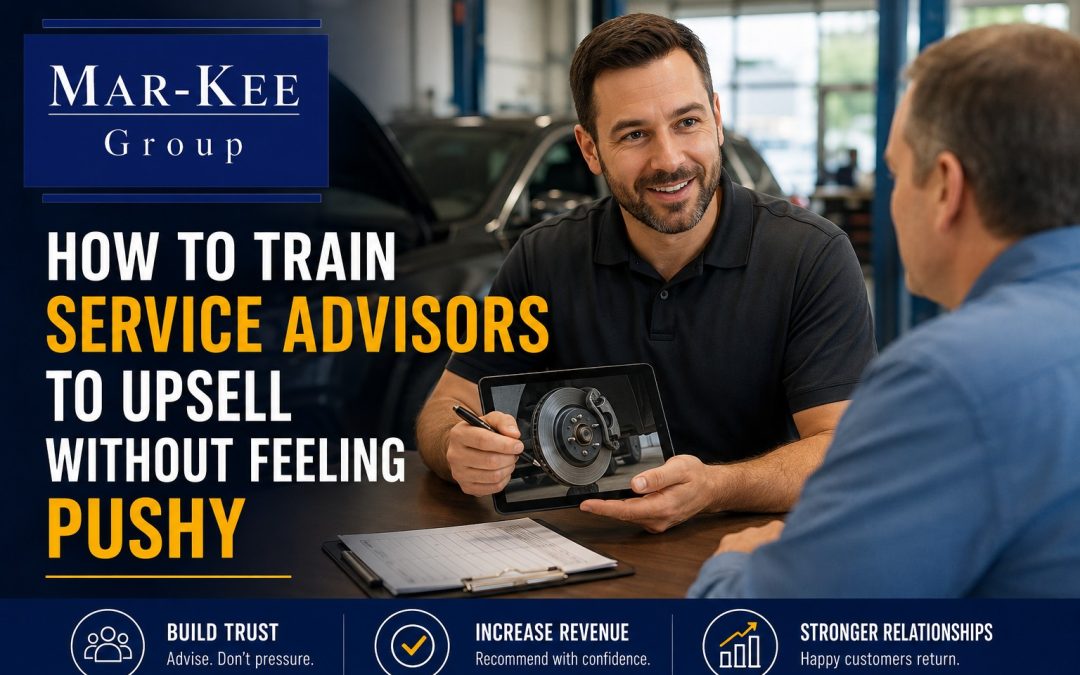
How to Train Service Advisors to Upsell Without Feeling Pushy
Every dealership wants more revenue from the service drive. But there’s a real fear that holds advisors back. They worry that recommending extra work will make them look pushy. That fear costs dealerships thousands of dollars in missed repair orders every month.
The good news is that service advisor upselling training doesn’t have to feel like a sales pitch. It can feel like good advice. When advisors learn to frame recommendations as care instead of a pitch, customers say yes more often. They also come back for their next visit.
This guide walks through how to build that kind of training program at your dealership.
Why Upselling Feels Pushy in the First Place
Most advisors were never trained to sell. They were trained to write up repair orders and move cars through the bay. So when a manager tells them to “upsell more,” they default to the only model they know: pressure.
Pressure sounds like this: “You really need to do this today.” It sounds urgent. It sounds transactional. And customers can feel it.
The fix isn’t to stop recommending services. The fix is to change how those recommendations get delivered.
Shift the Goal From Selling to Diagnosing
Customers don’t want to be sold. They want to understand what’s actually wrong with their vehicle. When advisors present themselves as diagnosticians instead of salespeople, resistance drops.
Train your advisors to walk through three steps with every recommendation:
- Show the evidence. A worn brake pad, a dirty air filter, a fluid that’s overdue. Let the customer see it, not just hear about it.
- Explain the risk. What happens if this waits another 3,000 miles? Keep it factual, not scary.
- Give the choice. “Here’s what I’d recommend, and here’s what happens if we wait. It’s completely up to you.”
This approach removes the pressure. It also builds credibility, because the advisor is educating rather than persuading.
Use Permission-Based Language
Small wording changes make a big difference in how a recommendation lands. Permission-based language keeps the customer in control of the decision.
Compare these two phrases:
- “You need new wiper blades.” (Pushy)
- “I noticed your wiper blades are cracked. Want me to add those to today’s service?” (Permission-based)
The second version respects the customer’s autonomy. It also opens the door for a simple yes, which is far easier to get than a “you need” statement ever will be.
Build a short list of permission-based phrases specific to your most common upsells. Practice them until they sound natural, not scripted.
Train With Role-Play, Not Just Handouts
Handing an advisor a laminated script rarely changes behavior. Role-play does. When advisors practice real conversations with real objections, the language sticks.
Set up regular role-play sessions where one advisor plays the customer and pushes back. “That sounds expensive.” “I’ll think about it.” “My last shop said I didn’t need that.” Practicing these responses in a low-stakes setting builds the confidence advisors need on the drive.
The Mar-Kee Group’s in-dealership service advisor training programs are built around exactly this kind of practical, scenario-based coaching, so advisors are prepared for the conversations they’ll actually have with customers.
Track Trust, Not Just Repair Order Dollars
Most dealerships measure upselling success by one number: average repair order value. That number matters, but it’s not the whole story.
Recent industry research found that <cite index=”2-1″>by the end of a service visit, 80% of customers say their service advisor earned their trust</cite>, and that shifts in advisor behavior can swing customer satisfaction scores by 40 to 60 points, according to a CDK Global service advisor report. Trust drives repeat visits and future vehicle sales, not just the current ticket.
Add these metrics to your advisor scorecards:
- Customer satisfaction scores tied to specific visits
- Repeat visit rate over 6 and 12 months
- Percentage of declined services that get accepted on a follow-up visit
These numbers tell you whether your advisors are building relationships or just closing tickets.
Make Coaching Ongoing, Not a One-Time Event
A single training session won’t change habits that have been reinforced for years. Upselling skills fade quickly without reinforcement.
Build a coaching rhythm into the service department. Short weekly check-ins work better than a single annual training day. Review a few recorded or role-played conversations. Celebrate the wins. Correct the misses early, before they become habits.
This is the same principle behind turning service appointments into repeat sales opportunities: consistency in the service drive builds the kind of trust that keeps customers coming back for both service and their next vehicle purchase.
Bring It All Together
Service advisor upselling training works best when it removes pressure instead of adding it. Advisors who diagnose instead of sell, use permission-based language, and get regular coaching close more recommended work without damaging trust.
If your service department is ready to build this kind of training program, explore the Mar-Kee Group’s service advisor and customer service training resources or reach out to learn how a structured coaching plan can raise your fixed ops revenue without turning your advisors into salespeople.
Recent Comments